




Blackmagic Design UltraStudio Express 3G — USB4 Capture & Playback Announced

Blackmagic Design has unveiled the UltraStudio Express 3G family — two compact, bus-powered USB4 devices that bring professional 3G-SDI and HDMI capture and playback to any Mac, Windows, or Linux system with a USB4 or Thunderbolt 4 port. At $175 each, they're the most affordable way to add broadcast-grade I/O to your laptop or desktop.
Whether you're a broadcast engineer setting up a mobile edit station, a streamer ingesting camera feeds into OBS, a colorist monitoring grades from DaVinci Resolve, or an institutional AV team archiving from legacy decks, the UltraStudio Express 3G lineup delivers a solution tuned to each specific task — without the cost or bulk of a combined I/O box.
In this article, we'll break down every spec, explain why Blackmagic Design split the workflow into two models, walk through all supported software and codecs, and help you decide which device — or whether both — belongs in your kit.
Meet the UltraStudio Express 3G Family
Rather than building a single combined capture-and-playback unit, Blackmagic Design took a deliberate design philosophy: dedicate each device to doing one thing exceptionally well. The result is two pocket-sized units that are simpler, cheaper, and more focused than any hybrid I/O box at this price.

UltraStudio Express Recorder 3G
Pocket-sized USB4 capture device with 3G-SDI and HDMI inputs. Ideal for live streaming, deck archiving, game capture, and broadcast ingest.

UltraStudio Express Monitor 3G
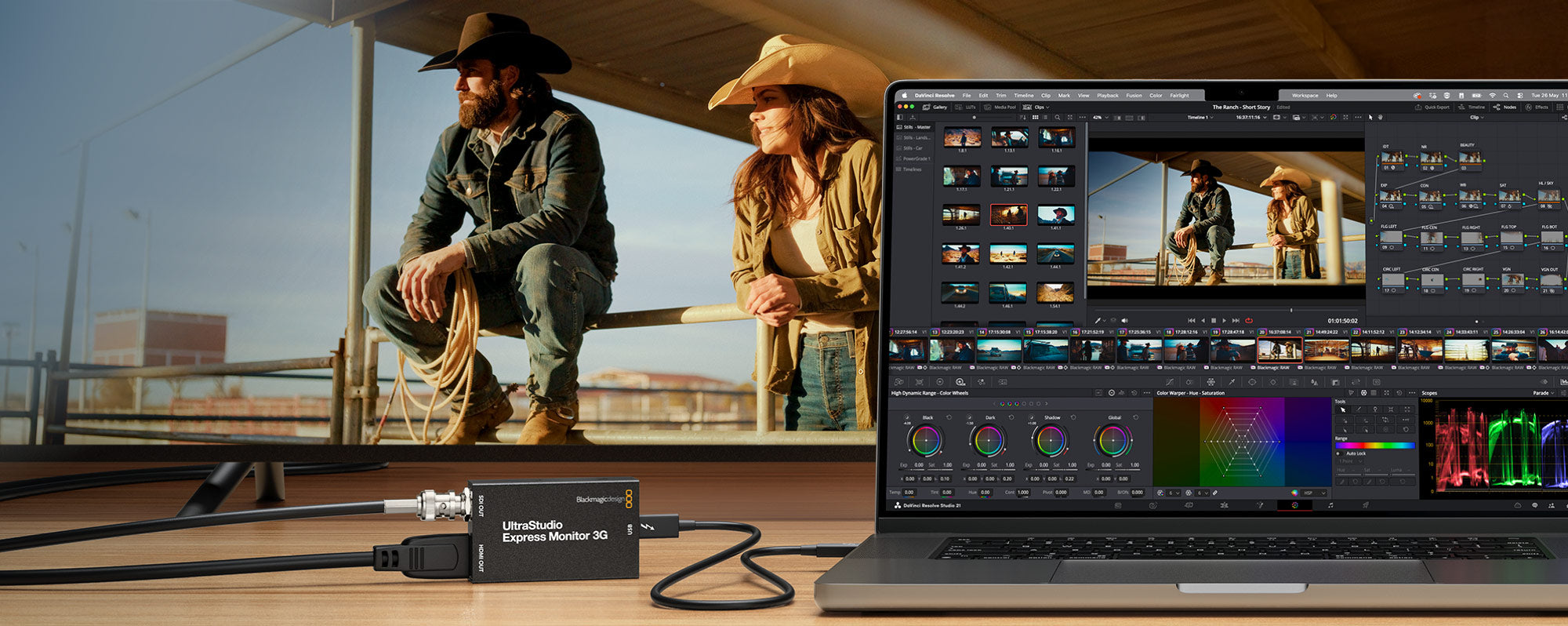
Pocket-sized USB4 playback device with 3G-SDI and HDMI outputs. Perfect for monitoring from DaVinci Resolve, Premiere Pro, Final Cut Pro, and broadcast graphics software.
Why Two Separate Models? The Logic Behind the Split
Some may wonder why Blackmagic Design didn't combine both functions into a single unit. The answer reflects real-world workflow realities that broadcast professionals know well.
A colorist grading in DaVinci Resolve needs pristine SDI output to a reference monitor — they have zero need for a capture input during that session. Conversely, a live streamer ingesting a camera signal into OBS or vMix needs a clean capture path and doesn't care about playback output. Building both functions into one device means both groups pay for hardware they'll never use.
- Live streaming via OBS Studio / Streamlabs
- Archiving from legacy broadcast decks (Betacam, DVCPRO, etc.)
- Game console capture for content creation
- Ingest into DaVinci Resolve, Premiere Pro, Media Composer
- AI image processing pipeline input
- On-set video capture into Media Express
- Broadcast monitoring from DaVinci Resolve
- Color grading on SDI reference displays
- Output from Final Cut Pro, Premiere Pro, Media Composer
- Broadcast graphics and playout monitoring
- On-set video village / director's monitor feed
- Visual effects preview via Fusion or After Effects
This focused design also keeps both units smaller and lighter than a combined I/O box, and means Blackmagic can price each at $175 — a value that would be impossible to achieve at the same quality level in a unified design.
What Is USB4? A Plain-English Explainer
USB4 is the latest generation of the Universal Serial Bus standard, announced by the USB Implementers Forum (USB-IF) in 2019 and built on the technical foundation of Intel's Thunderbolt 3 protocol. It is the fastest open-standard USB specification available, supporting data transfer speeds of up to 40 Gbps — four times faster than USB 3.2 Gen 2 (10 Gbps) and double the speed of USB 3.2 Gen 2×2 (20 Gbps).
Unlike previous USB generations that used multiple connector shapes (USB-A, USB-B, Micro-USB), USB4 is exclusively defined for the USB-C connector. The familiar oval-shaped, reversible USB-C port you find on modern laptops, smartphones, and professional equipment is the physical interface through which USB4 operates.
How USB4 Bandwidth Works
USB4's 40 Gbps bandwidth is bidirectional — meaning the full 40 Gbps is available simultaneously in both directions (sending and receiving). This is achieved by dynamically sharing the available bandwidth across multiple "tunneled" protocol streams: USB data, DisplayPort video, and PCIe signals can all travel over the same cable at the same time, with the bandwidth divided intelligently based on what's needed.
For video professionals, this architecture is significant. A single USB4 cable can carry high-bandwidth video data, control signals, and bus power simultaneously — which is exactly how the UltraStudio Express 3G devices operate. No additional cables for power, no separate control connections: one cable does everything.
USB4 vs. USB Generations at a Glance
| Standard | Max Speed | Connector | Typical Use |
|---|---|---|---|
| USB 2.0 | 480 Mbps | USB-A / USB-C | Keyboards, mice, basic peripherals |
| USB 3.2 Gen 1 | 5 Gbps | USB-A / USB-C | External hard drives, basic capture |
| USB 3.2 Gen 2 | 10 Gbps | USB-A / USB-C | Fast SSDs, basic 4K capture |
| USB 3.2 Gen 2×2 | 20 Gbps | USB-C only | High-speed storage arrays |
| USB4 (Gen 3×2) | 40 Gbps | USB-C only | Pro video I/O, eGPUs, high-res displays |
| USB4 Version 2.0 | 80 Gbps | USB-C only | Next-gen storage, dual 8K displays |
USB4 and Thunderbolt 4: What's the Difference?
Thunderbolt 4 is Intel's branded implementation of the USB4 specification with stricter minimum requirements. Both standards deliver 40 Gbps over USB-C and are electrically compatible — a USB4 device works in a Thunderbolt 4 port and vice versa. The practical differences come down to certification and guaranteed minimums:
- USB4 allows manufacturers to implement either 20 Gbps or 40 Gbps — so not all USB4 ports are equal. Always verify the port is rated for USB4 40 Gbps (sometimes labeled "USB4 Gen 3×2") when connecting professional video hardware.
- Thunderbolt 4 mandates 40 Gbps on every certified port, along with guaranteed support for two 4K displays, 32 Gbps PCIe data, and at least 15W power delivery. If a port carries the Thunderbolt 4 logo, you know it hits the ceiling.
- Both work with the UltraStudio Express 3G — Blackmagic Design specifies USB4 or Thunderbolt 4 compatibility, and either port type provides the full 40 Gbps the device needs.
Quick check: Look for the USB4 40Gbps label or the Thunderbolt 4 lightning bolt logo on your laptop port. Both confirm you have the bandwidth the UltraStudio Express 3G requires. These ports are standard on all Apple Silicon MacBooks (M1 and later), Intel 11th-gen and newer laptops, and AMD Ryzen 6000-series and newer systems.
USB4 at 40 Gbps: Why the Connection Type Matters for Broadcast Video
Both UltraStudio Express 3G models connect to your computer via a single USB Type-C connector running at USB4 speed — 40 gigabits per second. That bandwidth ceiling is the technical key to what makes these devices broadcast-capable at this price.
For context: uncompressed 10-bit 1080p60 4:4:4 video requires roughly 3–4 Gbps of sustained bandwidth. USB 3.2 Gen 2 (10 Gbps) left little headroom for control overhead and power delivery simultaneously. USB4's 40 Gbps ceiling, by contrast, provides the bandwidth to handle high-resolution video, deeper bit depths, and advanced frame buffer formats — including 10-bit 4:2:2 YUV and 10-bit 4:4:4 RGB — without compromise, while simultaneously delivering bus power to the device over the same cable.
Thunderbolt 4 Compatible: Thunderbolt 4 is electrically and logically identical to USB4 at 40 Gbps. Both UltraStudio Express 3G devices work with any USB4 or Thunderbolt 4 port — including the latest MacBook Pro, MacBook Air M4, Dell XPS, Lenovo ThinkPad, and modern workstations.
Bus-Powered: No Power Brick Required
One of the most practically significant features of both Express 3G devices is that they draw all operating power over the USB connection itself. You bring the laptop; the device runs from its battery. There are no power bricks, no additional cables, no wall outlets to locate in a dark arena or outdoor venue. For broadcast engineers and traveling editors, this single-cable simplicity is a meaningful workflow upgrade.
Full Technical Specifications: UltraStudio Express 3G
Here is a complete side-by-side comparison of both models across every key specification category.
| Specification | Express Recorder 3G | Express Monitor 3G |
|---|---|---|
| Function | Capture (Input only) | Playback (Output only) |
| Computer Interface | 1× USB Type-C® — USB4 / USB 40Gbps (Thunderbolt 4 compatible) | |
| Power | Bus-powered via USB connection (no external PSU required) | |
| SDI Connection | 1× 3G-SDI Input (BNC) | 1× 3G-SDI Output (BNC) |
| SDI Rates | 270 Mb/s, 1.5G, 3G (Level A / Level B switchable) | |
| SDI Audio (Embedded) | 16 channels embedded in SD/HD | 16 channels embedded in SD/HD |
| HDMI Connection | 1× HDMI 2.0 Type A Input | 1× HDMI 2.0 Type A Output |
| HDMI Audio (Embedded) | 8 channels embedded in SD/HD | 8 channels embedded in SD/HD |
| SD Standards | 525i59.94 (NTSC), 625i50 (PAL) | |
| HD Standards | 720p50/59.94/60, 1080i50/59.94/60, 1080p23.98/24/25/29.97/30/50/59.94/60 | |
| Max Resolution | 1920×1080p60 (1080p60) | |
| Color Sampling | 10-bit 4:2:2 YUV, 10-bit 4:4:4 RGB | |
| Compressed Formats | Apple ProRes (4444, 422 HQ, 422, 422 LT, 422 Proxy), DNxHD, DNxHR, HEVC, XDCAM HD422, XDCAM HD, XDCAM EX, AVC-Intra, AVCHD, HDV, DVCPROHD, DVCPRO50, DV-NTSC, DV-PAL, Canon XF MPEG2, DPX | |
| Uncompressed Formats | Uncompressed 8-bit 4:2:2, Uncompressed 10-bit 4:2:2, Uncompressed 10-bit 4:4:4 | |
| OS Support | macOS, Windows, Linux | |
| Included Software | Media Express, Disk Speed Test, LiveKey, Desktop Video Utility, Driver (Mac/Win); Desktop Video Utility, Driver (Linux) | Media Express, Disk Speed Test, LiveKey, Desktop Video Utility, Driver (Mac/Win); Desktop Video Utility, Driver (Linux) |
| API / SDK | DeckLink API — cross-platform SDK for Mac, Windows, and Linux | |
| Firmware Updates | Built into software driver; loads at system start or via updater | |
| MSRP | $175 USD | $175 USD |
| Available | Now — from Blackmagic Design resellers worldwide | |
UltraStudio Express Recorder 3G — Closer Look
The Recorder 3G is an input-only device. It accepts both 3G-SDI and HDMI 2.0 signals and delivers them to your computer over a single USB4 cable. With 16 channels of embedded SDI audio and 8 channels of embedded HDMI audio, it handles the full audio payload of professional broadcast signals without any external audio hardware.

UltraStudio Express Monitor 3G — Closer Look
The Mirror image of the Recorder, the Monitor 3G is an output-only device. It takes the video feed from your editing, color grading, or graphics software and outputs it to a professional 3G-SDI or HDMI display. SDI output at 10-bit gives colorists the reference-accurate signal path they need when monitoring to a broadcast-grade display or reference monitor.

Software Compatibility: Works with Your Entire Stack
Both UltraStudio Express 3G models use Blackmagic Design's DeckLink API — the same cross-platform SDK that powers every professional DeckLink card and UltraStudio device. This means software compatibility is exceptionally broad, spanning every major NLE, color grading application, VFX tool, and streaming platform.
Editing & Color Grading
- DaVinci Resolve — including built-in Fusion for VFX compositing and Fairlight for audio post
- Final Cut Pro — Apple's professional NLE for macOS
- Avid Media Composer — the broadcast and film industry standard
- Adobe Premiere Pro — with full Creative Cloud integration
- MAGIX Vegas Pro — Windows-based professional editing
Visual Effects & Motion Graphics
- Blackmagic Fusion — node-based VFX compositing (included free in DaVinci Resolve)
- Adobe After Effects — industry-standard motion graphics and VFX
- Adobe Photoshop — for still frame capture and compositing workflows
Live Streaming & Broadcast
- OBS Studio (Open Broadcaster Software) — free, open-source live streaming
- Streamlabs OBS — OBS-based streaming with integrated tools
- vMix — advanced live production software for Windows
- Wirecast — professional live streaming production
- AI image processing pipelines — the Recorder 3G is explicitly compatible
Included: Blackmagic Media Express
Both devices include Blackmagic Media Express — a simple capture and playback application that lets you ingest video into files immediately, without needing to open a full NLE. Files captured in Media Express can be loaded directly into Fusion, After Effects, or Photoshop for further work.
Supported Codecs & Formats
The UltraStudio Express 3G family handles an extensive list of codecs — far beyond what most capture devices at this price support. Both compressed and uncompressed workflows are covered at up to 10-bit depth.
That last codec — uncompressed 10-bit 4:4:4 RGB — is particularly noteworthy at this price. Full 4:4:4 chroma sampling is essential for compositing, green screen work, and high-end color grading pipelines where chroma accuracy directly impacts keying quality and color precision.
Real-World Use Cases: Who Needs the UltraStudio Express 3G?
Live Streamers
Capture broadcast cameras, SDI switcher feeds, or HDMI sources into OBS or Streamlabs via the Recorder 3G — at 10-bit quality that consumer capture cards can't match.
Colorists & Editors
Monitor your DaVinci Resolve timeline on a calibrated SDI display using the Monitor 3G — a single USB cable from your MacBook Pro to a professional reference monitor.
Broadcast Engineers
A portable capture or playout device for field work — no power brick, no rack hardware, just a pocket-sized unit that works from laptop power in any location.
Houses of Worship
Capture SDI feeds from existing broadcast infrastructure for live streaming, and monitor your graphics on SDI displays — all integrated into your current setup.
Content Creators
Record game console output via HDMI into the Recorder 3G for pristine, low-latency capture in Apple ProRes or uncompressed formats — no compression artifacts.
Archiving & Transfer
Connect legacy broadcast decks (Betacam, DVCPRO, etc.) via 3G-SDI into the Recorder 3G to digitize tape libraries at broadcast quality directly into your NLE.
"We know how important our UltraStudio models are to customer workflows, so we've been working hard to get them into more hands. By building these new models around USB4, we can keep them even more affordable so customers can plug into the computers they already use. They're extremely compact, they power from the USB connection so customers can even run them from their laptop battery. They're perfect for working anywhere!"
— Grant Petty, CEO, Blackmagic DesignDeveloper & OEM Support via the DeckLink API
The UltraStudio Express 3G family exposes the full DeckLink SDK — Blackmagic Design's free, cross-platform developer API for Mac, Windows, and Linux. This makes both devices immediately accessible to software developers building custom capture applications, AI pipelines, automation systems, and any workflow that requires programmatic access to professional video I/O.
Blackmagic Design's OEM team additionally supports manufacturers who want to integrate the hardware into their own products. Volume purchase discounts are available for qualifying projects, and engineering support is provided during development. For smaller volumes, devices are simply available through the global reseller network — including Coremicro.
How the Express 3G Fits Into the UltraStudio Lineup
The UltraStudio family spans a wide range of capability and price. Understanding where the Express 3G models sit helps you choose the right device for your needs.
| Device | Connection | Max Resolution | Function | Approx. Price |
|---|---|---|---|---|
| UltraStudio Express Recorder 3G (New) | USB4 / TB4 | 1080p60 | Capture only | $175 |
| UltraStudio Express Monitor 3G (New) | USB4 / TB4 | 1080p60 | Playback only | $175 |
| UltraStudio HD Mini | Thunderbolt 3 | 1080p60 | Capture + Playback | ~$625 |
| UltraStudio 4K Mini | Thunderbolt 3 | 2160p60 | Capture + Playback | ~$1,195 |
| UltraStudio 4K Extreme 3 | PCIe + Thunderbolt 3 |
2160p60 | Capture + Playback | ~$2,995 |
* Approx. prices reflect current US street pricing as of July 2026 and are subject to change. Express 3G models priced at $175 MSRP.
The Express 3G models are the entry point for professional broadcast-grade I/O. They cover every SD and HD format up to 1080p60 — which encompasses the vast majority of broadcast, streaming, and post-production workflows. If your workflow demands 4K capture or combined capture-and-playback in a single unit, the broader UltraStudio lineup at Coremicro covers those needs.
Integration with the Blackmagic Design Ecosystem
One of the most compelling reasons to choose Blackmagic Design capture and playback hardware is how seamlessly it integrates with the rest of the Blackmagic ecosystem. If you're already using DaVinci Resolve for editing and color, or an ATEM Production Switcher for live production, the UltraStudio Express 3G devices slot directly into your existing workflow without configuration complexity.
The Monitor 3G outputs the DaVinci Resolve video timeline to any 3G-SDI reference monitor with no additional setup — Blackmagic Design's driver installs as a system-level video output that Resolve recognizes immediately. Similarly, the Recorder 3G works natively with Blackmagic cameras and ATEM switcher SDI outputs as a capture source in any compatible application.
DaVinci Resolve & Fusion Workflow
For post-production professionals, the combination of the Monitor 3G and DaVinci Resolve Studio creates a complete mobile color grading station. Connect a calibrated SDI reference monitor, grade on your MacBook Pro, and output a reference-accurate 10-bit signal — all powered by the laptop battery, with no additional hardware. Fusion, which is integrated into DaVinci Resolve, also works with both devices for real-time VFX monitoring and capture workflows.
Availability & Pricing
The UltraStudio Express Monitor 3G and UltraStudio Express Recorder 3G are both available now from Blackmagic Design resellers worldwide, including Coremicro. Both models are priced at $175 USD each, excluding local taxes and duties.
Authorized Reseller: Coremicro is an authorized Blackmagic Design reseller based in Union City, CA. Both UltraStudio Express 3G models ship from the US. Contact our team if you have questions about volume purchasing, institutional orders, or integration into your existing broadcast setup.
UltraStudio Express Recorder 3G
3G-SDI + HDMI input. USB4. Bus powered. 10-bit 4:4:4. $175.
UltraStudio Express Monitor 3G
3G-SDI + HDMI output. USB4. Bus powered. 10-bit 4:4:4. $175.
Frequently Asked Questions
Do the UltraStudio Express 3G devices support 4K?
No. Both models support SD and HD video standards up to 1080p60. They do not support Ultra HD or 4K formats. If you need 4K capture or playback, the UltraStudio 4K Mini or UltraStudio 4K Extreme 3 are the appropriate options from the UltraStudio lineup.
Can I use both the Monitor 3G and Recorder 3G simultaneously on the same computer?
Yes. Since each device connects via a separate USB4 port (or USB4 hub), you can run both simultaneously — one for capture input and one for playback output — effectively creating a combined I/O setup with two purpose-built devices.
Do they work with USB 3.2 or older USB ports?
Both devices require USB4 (40 Gbps) or Thunderbolt 4 connectivity. They will not function at full capability over USB 3.2 (10 Gbps) or slower USB connections, as the bandwidth is insufficient for high-quality video transfer.
Is the DeckLink SDK included or separately licensed?
The DeckLink SDK is free to download from the Blackmagic Design Developer portal. There is no license fee for development or deployment.
Does the Recorder 3G support HDCP-protected signals?
HDCP (copy protection) on the HDMI input will prevent capture of protected content. The device is designed for professional broadcast sources, cameras, and non-protected signals. This is standard behavior across all professional capture hardware.
What cables are included?
Blackmagic Design includes a USB4 cable for the computer connection. BNC cables for SDI are not included. HDMI cables are not included. These are standard professional accessories available from Coremicro.
Conclusion: The Right Tool for Every Broadcast Workflow
The UltraStudio Express 3G family is a targeted, well-considered product release from Blackmagic Design. By splitting capture and playback into two $175 dedicated devices — and powering both over USB4 — they've created a pair of tools that are genuinely professional in capability, genuinely portable in form, and genuinely affordable for individuals, small teams, and institutions alike.
The Recorder 3G fills a real gap for live streamers, field broadcast engineers, archivists, and content creators who need clean 10-bit SDI and HDMI capture without paying for playback hardware they don't need. The Monitor 3G gives colorists, editors, and broadcast graphics operators a portable SDI monitoring output that integrates directly into DaVinci Resolve and every major NLE — powered by the laptop they're already carrying.
Together, they make a compelling pair for anyone who wants the full broadcast I/O picture in a compact, bus-powered form. Individually, each one solves its specific problem better than anything else in its price range.
Order Your UltraStudio Express 3G Today
Order now from Coremicro — your authorized Blackmagic Design reseller. Both models ship from the US at $175 each.
-
Posted in
Blackmagic Design